Managing jobsite debris requires dependable delivery schedules that prevent trade stacking and work stoppages. MetroForge Waste Services deploys roll-off bins with reinforced undercarriages designed specifically for…
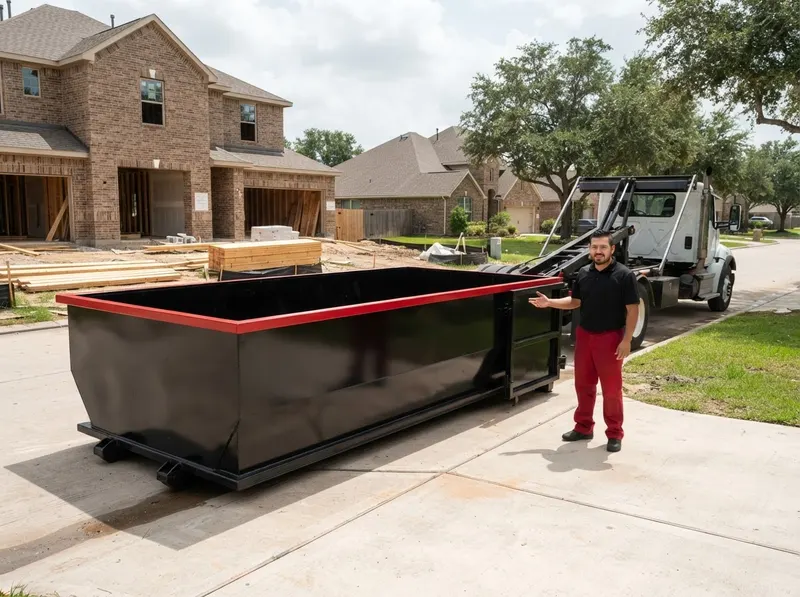
Managing jobsite debris requires dependable delivery schedules that prevent trade stacking and work stoppages. MetroForge Waste Services deploys roll-off bins with reinforced undercarriages designed specifically for active commercial jobs and residential development sites. A 20-yard container holds approximately 8 pickup truck beds of drywall and cut-offs, fitting standard build envelopes in Elyson or Cane Island, while high-volume structural overhauls near Katy Mills Mall require the 8-foot sidewalls of a 40-yard container holding 16 pickup truck beds of bulk demolition. For heavy flatwork, brick demolition, or earthwork, the 10-yard low-profile container provides reinforced weight distribution to prevent structural overloading in accordance with Texas Department of Transportation axle limits. Commercial operations must separate wet paints, refrigerants, and chemical solvents to adhere to United States Environmental Protection Agency hazardous containment rules, routing those specific items to specialized regional processing centers.
Site staging across commercial retail centers along Interstate 10, the Grand Parkway corridor, and mixed-use builds near Legacy Stadium demands meticulous surface care. Roll-off container steel wheels can exert several thousand pounds of point-load pressure on finished concrete or brick pavers. Every drop utilizes dual-layer blocking lumber directly beneath the contact points, eliminating surface scarification and gouging. On municipal rights-of-way within the City of Katy, containers placed outside private property lines require compliance with municipal traffic visibility standards. Projects inside master-planned communities like Cinco Ranch, Firethorne, and Jordan Ranch maintain strict commercial vehicle covenants enforced through property management guidelines aligned with Community Associations Institute standards, requiring roll-offs to remain parallel to property lines and clear of pedestrian paths.
On-site safety protocols mandate compliance with Occupational Safety and Health Administration standard 1926.252 for disposal chutes and bulk debris loading. When disposing of older framing materials or renovation scrap, contractors monitor composite materials via ASTM International grading standards to separate salvageable wood from composite waste. Structural steel, electrical conduit, and copper lines should be sorted prior to disposal, and project supervisors can reference Institute of Scrap Recycling Industries material classifications to divert clean metals from landfill streams. Gypsum board recycling protocols, established through the Drywall Recycling Council, allow clean drywall scraps to avoid landfill burial when segregated on-site. Regional environmental oversight from the Texas Commission on Environmental Quality governs transfer stations throughout Fort Bend County, ensuring commercial loads comply with state solid waste codes. Work sites operating under green building programs can align debris tracking sheets directly with U.S. Green Building Council LEED material diversion credits.
Every job gets a firm, written price after a free on-site visit.
For standards, safe disposal, and service guidance on DUMPSTER in Katy, TX, useful references include U.S. EPA, EPA, EPA, OSHA, Earth911, and Google Maps. General consumer and small-business resources are available from USA.gov, Better Business Bureau, FTC Consumer Advice, U.S. Small Business Administration, and Ready.gov.
Tell us about your commercial construction roll-offs job in Katy and we'll send a clear, written quote, usually the same day.
 MetroForge Waste Services